Parish: Kelton
Location Map: Ordnance Survey Grid Ref: NX 7161 5745
HES Record Click here for detail on Trove.scot
Description
Kirkcormack can be found roughly a quarter of a mile NNW from Mayfield Farm on the unclassified road from Rhonehpuse to Toungland. It is one of the earlier churches in the Stewartry of Kirkcudbright, and lay within the jurisdiction of Abbey of Iona until the late 12th century when Uchtred, Lord of Galloway granted the church to the Abbey of Holyrood.
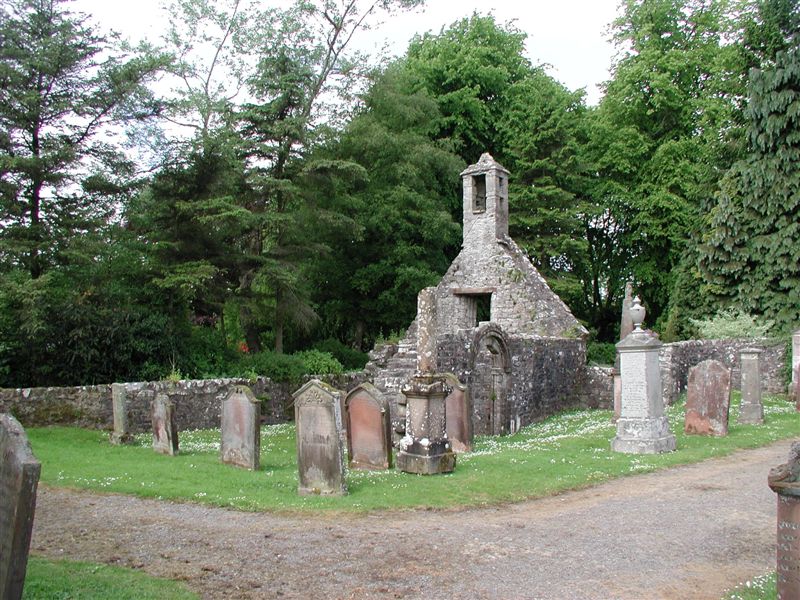
In the RCAHMS Inventory of 1914 the ruins of Kirkcormack are described as being situated within a wood in an angle formed by a sharp bend of the river Dee. The building, almost reduced to its foundations, measures interiorly some 12.5m by 5.8m.
Within the ruins lies a Sepulchral Slab towards the west end of the ruins. The flat slab 1.68m in length and 0.46m in breadth, is broken in two at 0.69m from the upper end. Carved in high relief in Gothic letters around the margin is the inscription:
Hic jacet honorabilis vir patricius macclbllan qui obiit ano d • • D° 34
At the head of the stone placed transversely is a shield bearing arms : Two chevronels with a star in base, while incised on the lower part of the stone there has been a sword with a broad blade or scabbard symmetrically pointed. At a later date an inscription in modern lettering partly translating the original inscription has been incised across the flat upper surface.
There is very little known about the church, and it is not until 1546 that we have then name of a vicar, Herbet Dun, who resigned and appears to have gone to Holyrood Abbey. He was succeeded by Robert Forrestar, who in 1585 fued the ecclesiastical lands of Kirkcormack to his brother Robert Forrestar.
The church was dedicated to Cormack as its name suggests. Skene in his Celtic Scotland states that Cormack was one of 4 Irish Saints to build monasteries in Scotland. St Cormack moastic site is unknown, but R C Reid writing the the Transactions of the Dumfries and Galloway Natural History and Archaeology Society in 1922/23 (s3 v10 p239) suggests the present ruins could be the site of the monastery, with evidence limited due to the nature of the buildings construction. There is no reason no to support this idea, but it could only be confirmed with further archaeological survey work and excavation.
The site was visted by the Royal Commission for Ancient and Historic Monuments and Constructions in Scotand in 1911. During 2004 we carried out a 1:50 hand survey of the remans.